Astrology & Love
AI Love Compatibility & Synastry: Can Astrology Predict Your Relationship Success?
By Spiritual Tech Lab on 2026-05-21 • 7 min read
AI Love Compatibility & Synastry: Can Astrology Predict Your Relationship Success?
We have all been there: you meet someone new, the sparks fly, and within hours, you find yourself sneaking onto an astrology app to check if your zodiac signs are compatible.
Whether it is checking if your Taurus Sun can handle a Sagittarius Leo cusp, or digging deeper into a complete birth chart compatibility report, love remains the number one reason people seek astrological guidance.
But standard zodiac compatibility tests often fall short. They look at your Sun signs alone (e.g., "Aries and Libra are opposites, so they attract") and ignore the other 90% of your astrological blueprint. A generic newspaper horoscope is like judging all of cinema by a 15-second clip.
Today, next-generation AI love compatibility calculators are changing the game. By parsing full birth charts—examining every planet, aspect, house, and Vedic Guna placement in fractions of a second—artificial intelligence provides deep, hyper-individualized relationship maps.
In this guide, we break down how AI reads relationship compatibility, what planetary connections (synastry) actually matter for long-term love, and how you can run a free AI-powered check on your own relationship.
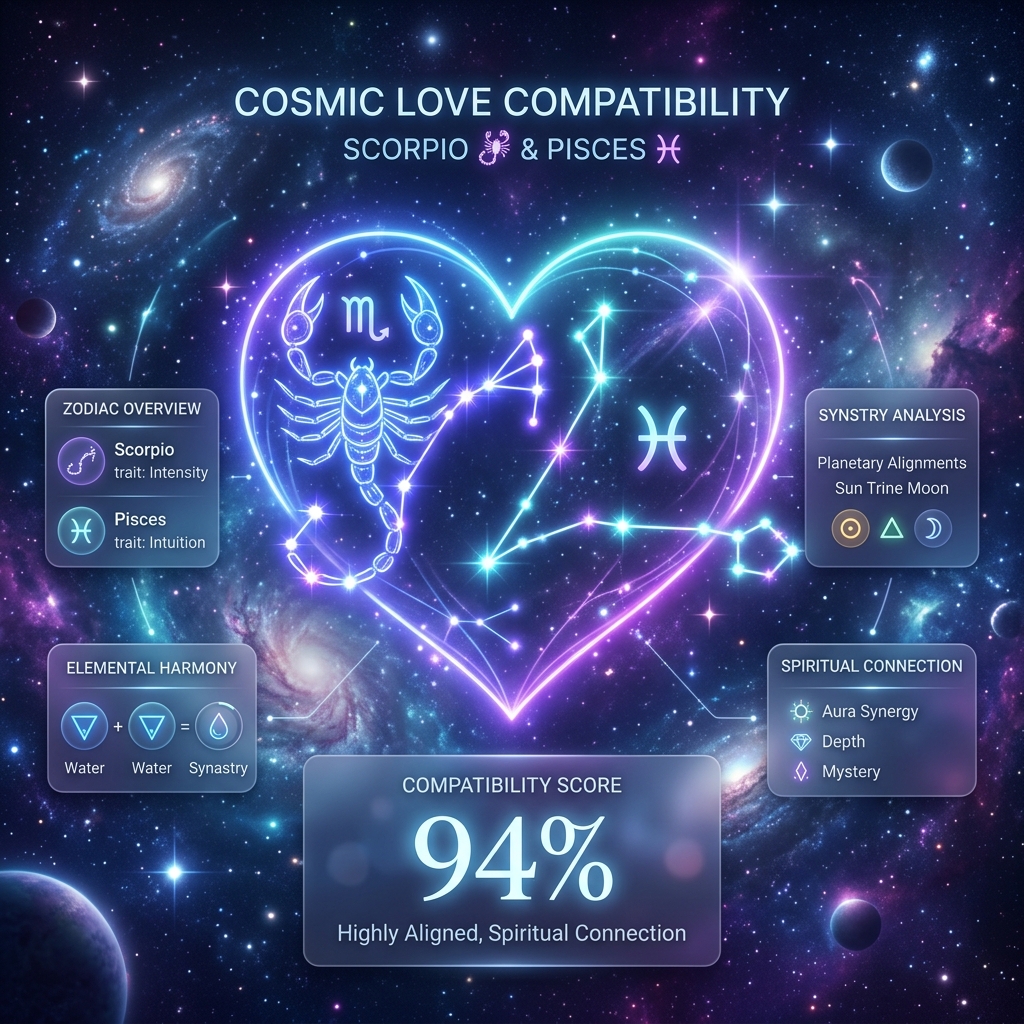
!AI Love Compatibility & Synastry
---
Why Sun Sign Compatibility is a Lie
If you've ever read that a Gemini and a Virgo are a bad match, or that Scorpio and Leo will constantly clash, you've been exposed to Sun-sign compatibility.
While the Sun sign represents your core identity and ego, a relationship involves two entire humans with complex emotional needs, communication styles, and attraction cues.
An AI relationship calculator overlays your complete charts to check multiple layers. You could have "incompatible" Sun signs, but if your Moons are in the same sign, you will feel an instant emotional bond and absolute comfort living together. Conversely, two people with "perfect" Sun sign compatibility might struggle to communicate if their Mercury placements are in harsh aspects.
---Western Synastry vs. Vedic Janam Kundli Milan
Vedic and Western astrology use different mathematical systems to calculate compatibility. An advanced AI engine like Nummi synthesizes both systems to give you a complete relationship profile.
1. Western Synastry (Aspect Matching)
Western astrology overlays one person's birth chart directly on top of another's. The AI then measures the mathematical angles (aspects) between their planets: * Trines (120°) and Sextiles (60°): Harmonious flows of energy where things feel natural, easy, and supportive. * Conjunctions (0°): Intense blending of energies, which can be highly magnetic or overwhelming depending on the planets involved. * Squares (90°) and Oppositions (180°): Points of friction. While challenging, these aspects often provide the growth, excitement, and sexual tension that keep relationships alive. A chart with zero squares is often boring.2. Vedic Kundli Matching (Guna Milan)
Traditional Indian astrology uses the Ashtakoot system, which evaluates 8 different aspects of the partners' Moon placements (since the Moon governs the mind and emotions in Vedic wisdom). The AI calculates a score out of 36 Gunas (points): * Under 18 Gunas: Not recommended. Represents significant mental friction or divergent life directions. * 18 to 25 Gunas: Good compatibility. A solid foundation for a healthy partnership. * 26 to 32 Gunas: Excellent alignment. Highly harmonious emotional and mental synergy. * 33 to 36 Gunas: Rare and spiritual connection, though sometimes lacks the friction needed for physical attraction. ---The Pillars of Love: What an AI Compatibility Calculator Analyzes
A true relationship analysis goes far beyond your Sun sign. If you calculate compatibility using a premium tool, the system parses four essential relationship indicators:
| Planetary Connection | What It Rules in a Relationship | Why It Matters | | :--- | :--- | :--- | | Moon to Moon | Emotional Safety & Instincts | Governs how you handle conflict, comfort each other, and coexist daily in the same house. | | Venus to Mars | Romantic Attraction & Chemistry | Venus rules what you find beautiful and how you show love; Mars rules desire, passion, and sexual drive. | | Mercury to Mercury | Communication & Intellect | Determines if you understand each other's jokes, how you argue, and if you can talk for hours. | | Saturn to Sun/Moon | Longevity & Commitment | Saturn represents karma, responsibility, and structure. Strong Saturn connections bind people together for years. | ---Astrological Red Flags: Doshas & Hard Aspects
In addition to positive scores, an AI calculator flags critical astrological warning signs, such as:
* Manglik Dosha (Vedic): An imbalance of Mars energy. Mars is the warrior planet. When it sits in specific houses (1st, 4th, 7th, 8th, or 12th), it can lead to explosive arguments and control issues if not neutralized by the partner's chart. An AI can calculate if the Dosha is cancelled by other balancing placements.
* Saturn Square Venus (Western): An aspect that suggests feelings of emotional distance or duty taking precedence over joy, requiring conscious effort to overcome.
* Rahu-Ketu Axis Overlays: When one partner's lunar nodes fall on the other's personal planets, it creates a powerful, obsessive "karmic" attraction that feels like they've known each other for lifetimes. However, it requires maturity to prevent obsession from turning toxic.
Why AI is Better Than Traditional Horoscopes for Couples
Traditional compatibility reports give you a static PDF with paragraphs of generic text. You read it once, and then you are left wondering: *"Okay, but what does this mean for our current argument about money?"*
Conversational AI platforms like Nummi solve this by offering dynamic, ongoing relationship counseling:
1. Context-Aware Dialogues: You can ask the AI, *"My partner is a Gemini Moon and I am a Scorpio Moon. Why do we react differently to stress?"* The AI will explain the air-water mismatch and suggest communication exercises.
2. Vibe Check Metrics: By connecting to active transit calendars, the AI can alert you to challenging periods: *"Mars is currently square your partner's Venus. They might feel irritable this week—give them some space."*
3. Real-Time Synastry Chat: Rather than memorizing astrological terms, you talk to the companion as if it were a mutual friend who happens to know both of your charts inside out.
Frequently Asked Questions (FAQ)
What is the difference between a Synastry Chart and a Composite Chart?
A synastry chart overlays two individual birth charts to see how their planets interact (Person A's Venus on Person B's Mars). A composite chart combines the two charts by calculating the mathematical midpoints between their planets, creating a single "relationship chart" that represents the relationship itself as a third entity.Can an "incompatible" chart still result in a successful relationship?
Absolutely. Astrology shows tendencies, energy flows, and areas of potential friction. It is not fatalistic. Awareness is key. If the AI highlights a communication mismatch (e.g., Mercury square Mercury), you can consciously practice active listening. Free will and emotional maturity always override negative chart aspects.What is Guna Milan?
Vedic Guna Milan is calculated based on the position of the Moon in both charts at birth. It scores eight areas (Kootas) representing elements like temperament, dominance, physical attraction, and spiritual alignment, totaling 36 points. ---Get Your Synastry Compatibility Report Now
Do not settle for simple sun-sign compatibility lists. If you want to know if you and your partner (or crush) are aligned on a deeper, spiritual level, use a complete astronomical engine.
With the Nummi App, you can input both of your details to generate a complete synastry report, check your Guna Milan score, identify any Doshas, and have a live, private chat with your AI companion to navigate your relationship's unique cosmic dynamics.